Osteoglossiformes (Bony tongues)
Elopiformes (Tarpon / Tenpounders)
- Elops sp.
- Esocelops cavifrons
- Protarpon (Megalops) oblongus
- Protarpon (Megalops) priscus
- Promegalops sheppeyensis
- Promegalops signeuxae
- Undescribed Elopiformes
Aulopiformes (Grinners & Lizardfish)
Beryciformes (Soldier/Pricklefish)
Scombriformes (Mackerel & Tuna)
- Eocoelopoma colei
- Eocoelopoma curvatum
- Eocoelopoma gigas
- Micrornatus hopwoodi
- Scombramphodon crassidens
- Scombramphodon sheppeyensis
- Duplexdens (Scombrinus) macropomus
- Scombrinus nuchalis
- Sphyraenodus priscus
- Tamesichthys decipiens
- Wetherellus brevior
- Wetherellus cristatus
- Wetherellus longior
- Woodwardella patellifrons
- Palaeocybium proosti
- Bramoides brieni
- Goniocranion arambourgi
- Undescribed Scombrid #1
- Undescribed Scombrid #2
Carangiformes (Jack Mackerels)
- Enniskillenus radiatus
- Cylindracanthus rectus
- Hemirhabdorhynchus elliotti
- Acestrus elongatus
- Acestrus ornatus
- Aglyptorhynchus venablesi
- Xiphiorhynchus priscus
Pycnodontiformes (Pycnodonts)
Scientific Classification
Class: Actinopterygii (Ray-finned Fish)
Superorder: Pycnodontomorpha
Order: Pycnodontiformes (Pycnodonts)
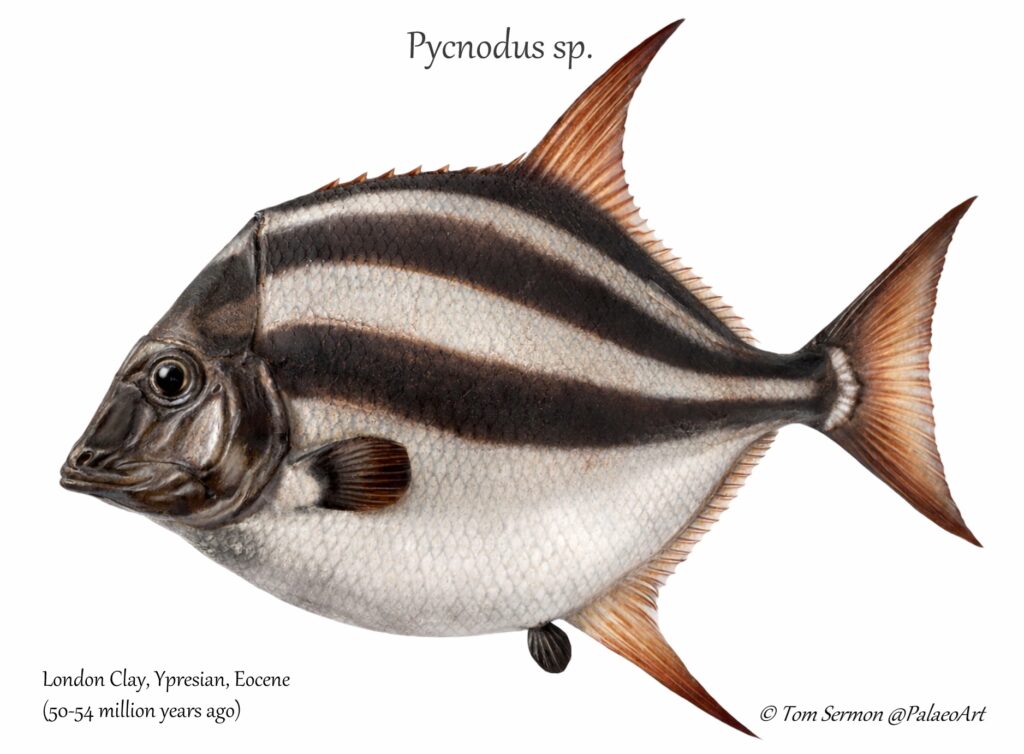
Pycnodontiformes are an extinct order of marine fish which have no living members but survived from the Late Triassic through to the Eocene. This means that those species of Pycnodontiformes found in the London Clay are amongst the final species to have represented this group.
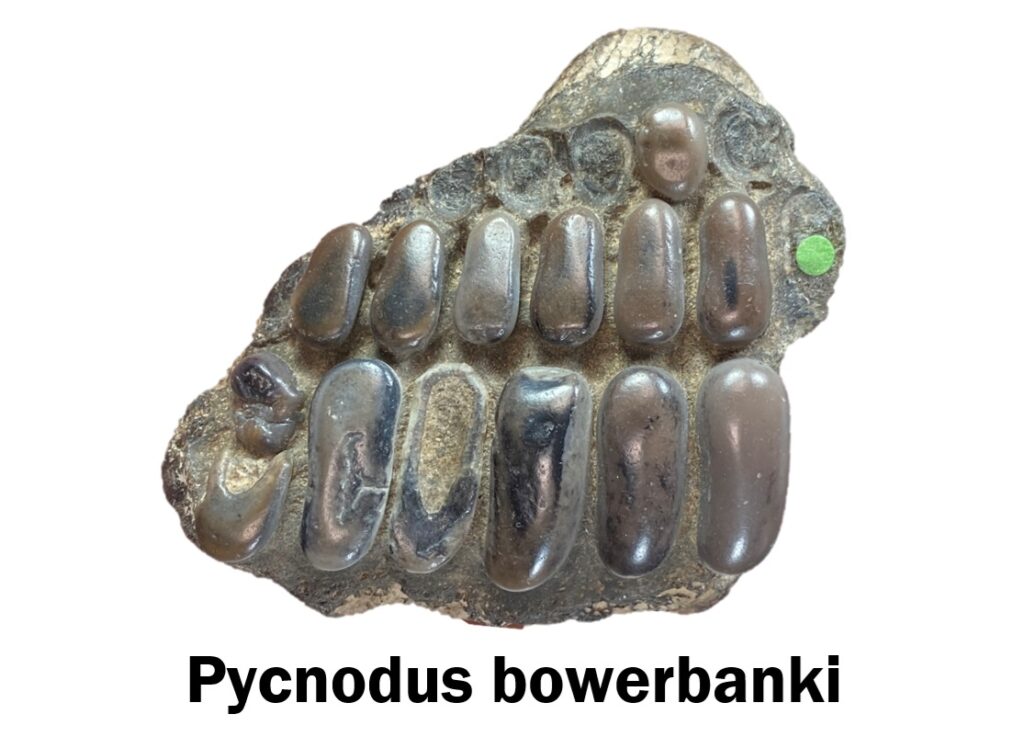
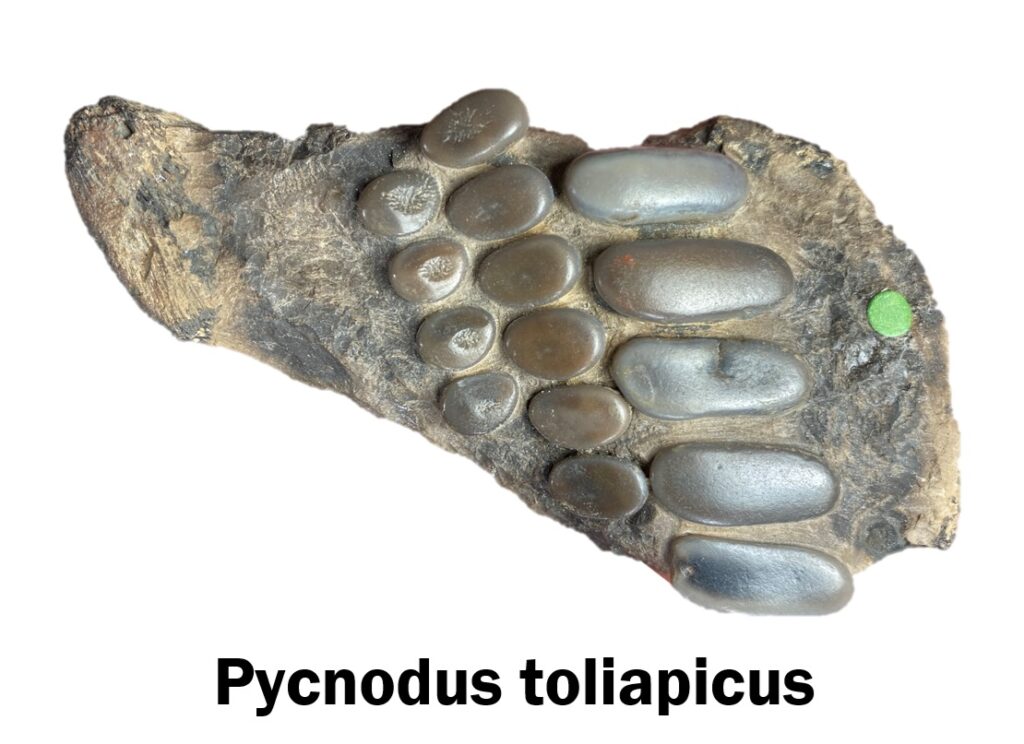
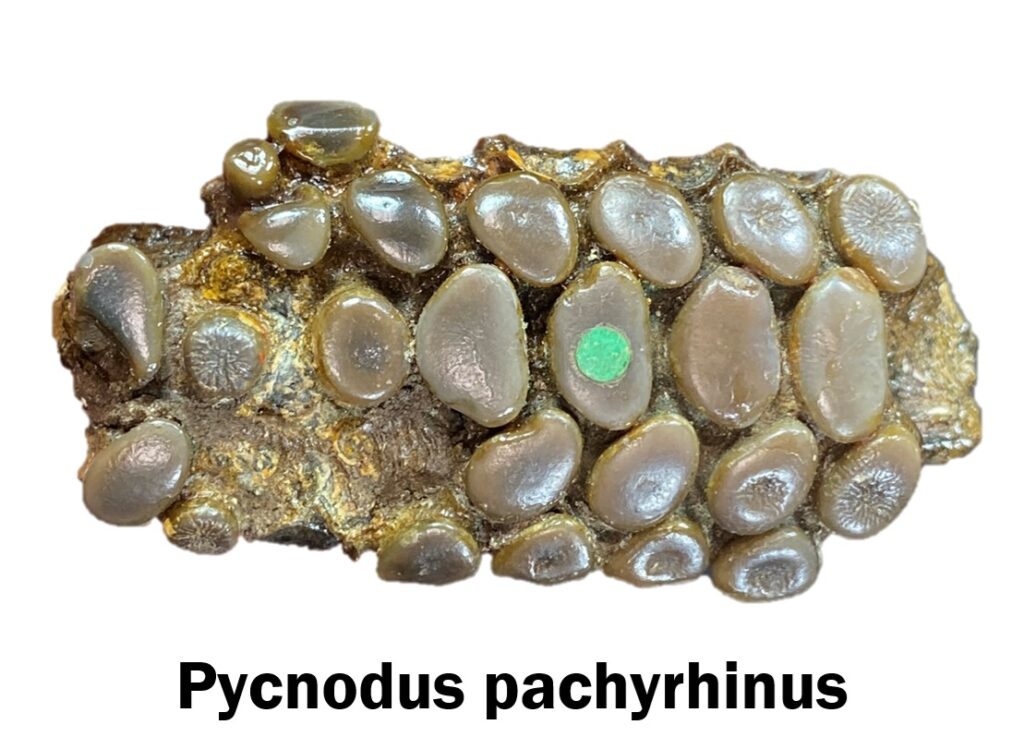
One distinguishing characteristic of this group is the presence of flat, crushing teeth on the both the lower and upper jaws which helped with crushing the exoskeletons of their prey such as crabs, urchins or molluscs.
This is an artistic reconstruction of a Pycnodont fish from the London Clay. Currently only teeth palates have been found, so the form of this reconstruction has been taken from more complete specimens from other formations.